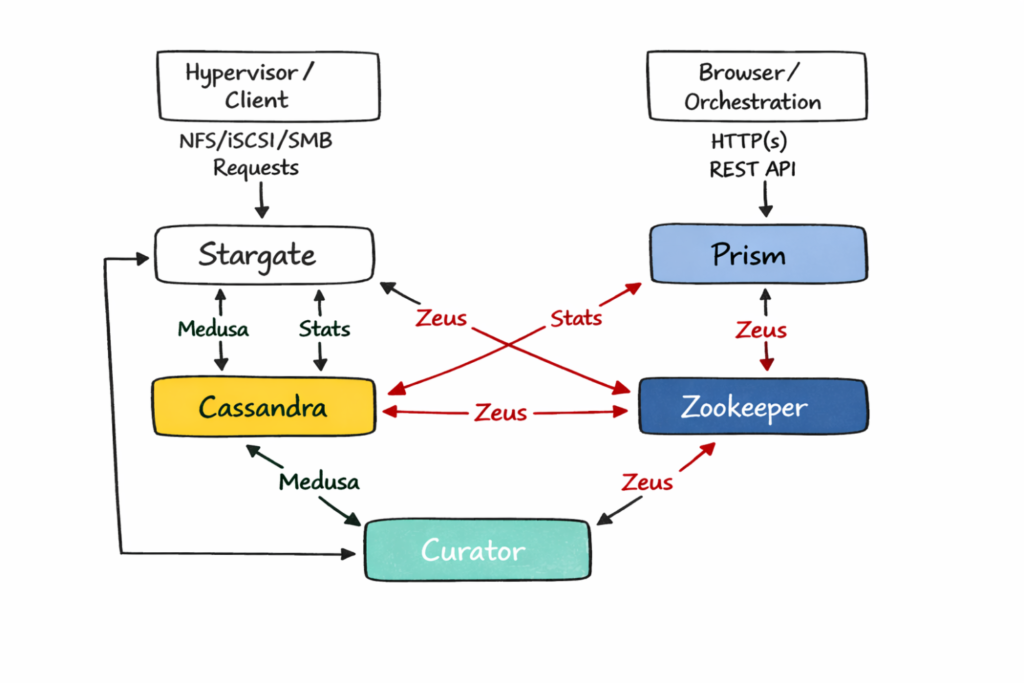
In the world of modern infrastructure, Nutanix has redefined how enterprises think about compute, storage, and virtualization. As PreSales engineers, understanding the core components and architecture of Nutanix isn’t just technical know-how — it’s key to articulating value, simplicity, and business impact to our customers.
Let’s break it down into clear layers that can help you position Nutanix during Discovery, Demo, and Technical Validation.
1. The Core of Nutanix: Hyperconverged Infrastructure (HCI)
At its heart, Nutanix is a software-defined HCI platform that converges compute, storage, and networking into a single, scalable cluster.
Instead of managing multiple silos — separate servers, SAN arrays, and hypervisors — Nutanix aggregates these into a shared resource pool. Each node in a Nutanix cluster runs a Controller VM (CVM), which handles all I/O and storage operations.
2. Core Nutanix Components (Service Layer)
Cassandra
- Key Role: Distributed metadata store
- Description: Cassandra stores and manages all of the cluster metadata in a distributed ring-like manner based upon a heavily modified Apache Cassandra. The Paxos algorithm is utilized to enforce strict consistency. This service runs on every node in the cluster. The Cassandra is accessed via an interface called Medusa.
Zookeeper
- Key Role: Cluster configuration manager
- Description: Zookeeper stores all of the cluster configuration including hosts, IPs, state, etc. and is based upon Apache Zookeeper. This service runs on three or five nodes, depending on the redundancy factor that is applied to the cluster, one of which is elected as a leader. The leader receives all requests and forwards them to its peers. If the leader fails to respond, a new leader is automatically elected. Zookeeper is accessed via an interface called Zeus.
Zeus
- A key element of a distributed system is a method for all nodes to store and update the cluster’s configuration. This configuration includes details about the physical components in the cluster, such as hosts and disks, and logical components, like storage containers. The state of these components, including their IP addresses, capacities, and data replication rules, are also stored in the cluster configuration.
- Zeus is the Nutanix library that all other components use to access the cluster configuration, which is currently implemented using Apache Zookeeper.
Stargate
- Key Role: Data I/O manager
- Description: Stargate is responsible for all data management and I/O operations and is the main interface from the hypervisor (via NFS, iSCSI, or SMB). This service runs on every node in the cluster in order to serve localized I/O.
Curator
- Key Role: MapReduce cluster management and cleanup
- Description: Curator is responsible for managing and distributing tasks throughout the cluster, including disk balancing, proactive scrubbing, and many more items. Curator runs on every node and is controlled by an elected Curator Leader who is responsible for the task and job delegation. There are two scan types for Curator, a full scan which occurs around every 6 hours and a partial scan which occurs every hour.
Prism
- Key Role: UI and API
- Description: Prism is the management gateway for component and administrators to configure and monitor the Nutanix cluster. This includes Ncli, the HTML5 UI, and REST API. Prism runs on every node in the cluster and uses an elected leader like all components in the cluster.
Genesis
- Key Role: Cluster component & service manager
- Description: Genesis is a process which runs on each node and is responsible for any services interactions (start/stop/etc.) as well as for the initial configuration. Genesis is a process which runs independently of the cluster and does not require the cluster to be configured/running. The only requirement for Genesis to be running is that Zookeeper is up and running. The cluster_init and cluster_status pages are displayed by the Genesis process.
Chronos
- Key Role: Job and task scheduler
- Description: Chronos is responsible for taking the jobs and tasks resulting from a Curator scan and scheduling/throttling tasks among nodes. Chronos runs on every node and is controlled by an elected Chronos Leader that is responsible for the task and job delegation and runs on the same node as the Curator Leader.
Cerebro
- Key Role: Replication/DR manager
- Description: Cerebro is responsible for the replication and DR capabilities of DSF. This includes the scheduling of snapshots, the replication to remote sites, and the site migration/failover. Cerebro runs on every node in the Nutanix cluster and all nodes participate in replication to remote clusters/sites.
Pithos
- Key Role: vDisk configuration manager
- Description: Pithos is responsible for vDisk (DSF file) configuration data. Pithos runs on every node and is built on top of Cassandra.